Showing posts with label India. Show all posts

Monday, 11 May 2015

When the earth shook but time stood still...

There was a strange commotion about the place. Even before we approached the heart of the town, everybody seemed to be out on the streets. It could not merely be explained by the fact that it was a Saturday, in fact Saturday is not even weekend in this part of the world. Suddenly the vehicle stopped and the driver lurched out suspecting a puncture. It was then that the realization of an earthquake sunk in. It was then that the 'commotion' began to make sense. With a hectic schedule lined up for a long day ahead of us, there was little one could do except dismiss it as a minor aberration and go ahead with one's life as usual. Yet, there is always an unsettling feeling about the safety and security of our loved ones when we are far from them. The fact that we could not contact our families immediately afterward just reminded us of the similar need everybody must have felt at a juncture when the ground beneath our feet shakes and this time, quite literally!!

Alone in my room as we reached our destination, I began to ponder if the tremors we had dismissed as minor aberrations a little while earlier had indeed upset the happiness and lives of a chunk of humanity somewhere in a not so distant corner of the world. Before my thoughts could even find an expression, the aftershocks began. As the door swung like a pendulum, and the walls swayed, no uncertainty remained about the magnitude of the catastrophe unfolding somewhere in the neighbourhood. As we silently prayed for the lives and safety of our loved ones across the world, the news updates streaming in from the mobile apps, just served to lend credence to our worst nightmares. Not only had the upheaval affected millions nearby, but also where we were standing while reading these news, was dangerously close to the epicenter of the seismic shocks. 

Next couple of hours as we flitted in and out of meetings, a new realization began to dawn upon me. I could no longer content myself with the fact that everybody in immediate family and friends was safe and secure, rather being at the helm of affairs in an assignment which concerns young children, I was hoping and praying that none of our kids suffer in any manner. As it took time for my faculties to respond, we could only send directions across the State to relay any information of any damage whatsoever and put any rumors and misgivings to rest. Thankfully there wasn't much.

Despite all the damage and the losses that the quake brought in its wake, it was not what had hit me the most. What I saw over the course of the next 24 hours was far more devastating to me on a personal level. Not that anything is terribly wrong per se but just that while we rue about the lives that had been lost in the wake of a
disaster, how I wish we could develop the empathy to rue over the precious lives we are letting go of unknowingly and unhurriedly each day. As we make tall claims of being modern and civilized and enlightened, as we go about showcasing and marketing stories of our success and as we begin to believe in the truth of the stories scripted by us, we could not be more wrong. As one of my favorite authors Khaled Hosseini puts it, "Children aren't coloring books. You don't get to fill them with your favorite colors." Yet this is precisely what we have been doing all along. It is one thing to be apathetic but quite another to feel something for our own kids but not the same for others'. It was different earlier but now when I look at these angelic souls I see the face of my two year old in each one of them, as if asking me some questions with absolute faith and innocence. Much as I may wish, it is beyond my belief and power to answer all the questions they silently put forth or to even give them hope of a life that they are building dreams of. In moments such as these, I find myself and these little ones being stuck in a time warp. I shall never be able to find the courage to acknowledge that their lives will perhaps be no better or different from the lives of hardships that their parents have led and much as they may strive there will always be a huge chasm separating them from their 'truly blessed' counterparts in the gleaming metropolises. At the end of the day, the questions we ask of ourselves determine the type of people that we will become. Whatever I may do, I can not help but say..

“Come away, O human child!
To the waters and the wild
With a faery, hand in hand,
For the world's more full of weeping than you can understand.” 
― W.B. Yeats, The Collected Poems


Tuesday, 9 September 2014

The Far Pavilions.. Tales of Badshahi Bagh

Year 2009

The first assignment in any profession is often the the most difficult and challenging seemingly. Add to it the fact that one is posted in an outlying rural sub-division and has no idea of how to go about dealing with people's expectations in such a remote and inaccessible corner of the state (if not country), and one feels one is doomed to fail miserably. With these innumerable apprehensions and the pain of being away from family and friends for quite some time to come, I decided to test my luck as the Sub-Divisional Magistrate in Agra's Fatehabad. With a rickety jeep to take me around and a dusty country road winding through endless row of farmsteads, I embarked upon my journey to begin the first chapter of my professional life. 


The irony of the situation however remains the awe it evoked whenever my parents would mention Fatehabad. To the minds of common people and millions of tourists across the world, Fatehabad meant the eponymous Fatehabad Road which houses some of the best and the most luxurious hotels in this part of the world. How were I to explain that beyond that 10 km of urban fringe, a completely different world awaits to tell a story only a minuscule fraction of people come to know of.

I still remember that Tuesday of 18th August, 2009. While the journey seemed to be a trial of sorts with the clouds of dust billowing in from the sides and the risks of driving on a country road where numerous modes of transport ply according to their own timetable the only thing I remembered was when the driver swerved the vehicle on a small arterial road outside the tiny township of Fatehabad and massive walls of a fort-like structure greeted us from a distance. 

I was super-excited to know about the existence of a historical fort in my sub-division. Only that the next moment, as the jeep entered through the magnificent front-gate of the fort was I made to realize that this very walled campus serves as the office of the Sub-Divisional Magistrate (SDM). And it not just serves as the office of revenue establishment (of which SDM is a part), but also that of Police, Judiciary, hundreds of advocates and to top it all, houses a Community Health Center too! With my city-bred sensibilities and then little knowledge of the parameters which govern the protection and preservation of our heritage as per law, I expressed my outrage and disgust at the gross neglect and misuse to which the wonderful structure was being subjected to.

Over the course of next few weeks, I had to dig deeper into the history of a place left forgotten in the middle of nowhere. Soon I learnt that it was here in May 1658 that Aurangzeb defeated his brother Dara Shikoh in the battle of Samugarh and usurped power from the Mughal Emperor Shahjehan.

In his book 'The Peacock Throne: The Drama of Mogul India', Waldemar Hansen writes:
"For India, Samugarh was perhaps the most decisive military engagement that had ever been fought and lost. Far from settling a petty family dispute over a crown, the disaster presaged three hundred years of vital events: British conquest, the ultimate division of Pakistan and India, Hindu Moslem feuds, and endless bloodshed. Medieval Mughal splendor had ended; the so-called age of Akbar, with its liberal coalition of Moslem and Hindu, its fused nationalism in politics and art, was gone forever. Aurangzeb would see to that".

             Battle of Samugarh, 1658


Even as we strived in our own little ways to preserve the structure and prevent further damage by increased activity inside the premises, when we downloaded a Google Earth satellite image to lend credence to our case, I was mesmerized by the perfect square of green which looked like an oasis in an area which is otherwise largely dry. Back then too, availability of water was a huge concern and was taken care of by the four wells which exist till date outside the four corners of the walled campus. There was also a beautiful pond with chhatris at a short distance from the fort and if not for the ever-expanding encroachments, it might be still existent. Even the residence where the Tehsildaar resided at a distance from the campus, was of Mughal vintage and had served as the stables of Maratha Daulat Rao Scindia for a couple of decades in the early 19th century.


As a new entrant into service, I wrote an agitated email to to the senior members of the service seeking guidance about the possible avenues of conservation of the historical structure. Back then while a lot of members extended advice, INTACH and ASI expressed their helplessness in view of an almost non-existent tourist potential. While I got transferred in April 2010, I continued to harbor a hope for the revival of the place and made it a point to share the same with whoever might care to listen.


Fast forward to the year 2014


Its been five years since I left the place and anybody ever mentioned Fatehabad again. Somewhere deep down inside, I too had reconciled with the current state of neglect of our heritage in most parts of the country. My stint in Bundelkhand had already bled my heart to the extent that I would shiver to visit a forgotten monument ever. Yet, on a completely unrelated visit to the office of my the then boss in Agra, on this fine morning of 4 September, 2014 here in Lucknow, he hands me a document enlisting the details of historical monuments in Uttar Pradesh, INTACH has decided to conserve in near future. My heart skips a beat to find a mention of Badshahi Bagh, Fatehabad in the list and while it seemed to have been erased from mind and memory, I once again glimpsed the familiar pavilions of Badshahi Bagh. While my contribution to the chain of events might be non-existent altogether, the fact that somebody had decided to take notice of a magnificent ruin in the vast hinterlands of the city of Taj is heartening enough and felt like a personal achievement of sorts. While I believe in a magic which makes things move in this universe, was it just a coincidence that the news was shared with me by the same person who was just as churned up as I was back then in Agra in 2010?

 "But why, you ask me, should this tale be told
To men grown old, or who are growing old?
It is too late! Ah, nothing is too late
Till the tired heart shall cease to palpitate."

-Morituri Salutamus
 HENRY WADSWORTH LONGFELLOW


Tuesday, 19 August 2014

Turning 31 and the challenges of being an academician!

31st birthday is not a happening event in any case. Its not even as if one is completing a decade of existence. Add to that the fact that one's best friends (the likes who are credited in blog posts)do not even remember and an eighteen month old constantly tugs you down, one can not help but wish one could stay 10 forever. As a kid I hated the fact that my birthday would fall on a National Holiday every year. Since it would always be a holiday at school, I could never attend school in a new dress and distribute sweets to my classmates on the day of my birthday. Today, being a civil servant,I have a duty to attend the flag-hoisting early in the morning and other such official engagements planned for the day. I can not recall a birthday when I could claim the day for myself and just let things be!

However, it did not turn out to be as bad as I might have made it sound. To look at 200 (officer-)trainees present during the flag-hoisting in formal attire and everybody lending their voice to the singing of our National Anthem fills one heart with pride for one's country. It is on occasions such as these that one can feel the idea of 'unity in diversity' and however much we may differ, our respect for our nation and national symbols really shines forth.

And while my dear friends forgot my b-day in their own official engagements, my dear colleagues R and S surprised me by gifting me a beautiful bouquet of flowers each. While the flowers would dry out in time, it is the memory of this gift that would linger forever.My sisters and family would never fail to wish me on this day, however near or far they may be! More surprisingly, while a boisterous party was insisted upon on this occasion last year, a lot has changed in this one year and me, A and little N celebrated the day all by ourselves gorging on fabulous mushroom-cheese enchiladas and penne farmhouse for dinner!

I may not have mentioned it before, but in the kind of profession that one is in, the chances of coming across an academic assignment are rather slim. And even when one talks about academics, its not as if one is studying/teaching literature or pure sciences, rather one has the task of training fresh entrants into the service or mid-level government officers  by equipping them with latest tools and  basic skills essential for being an effective administrator. While it is easy to conduct sessions which are objective like legal theory, the real challenges arise when it comes to abstract notions like leadership, humility, perseverance. As a Course Director, one constantly worries that the inherent bias of a speaker/faculty member may be imprinted upon the receptive minds forever.

Also certain aspects of certain professions (read government service!) are rather 'intoxicating'. For one, there is a sense of 'having arrived' on the scene. It just doesn't stop at that. Even in a profession where most of the perks and promotions are safeguarded by law, there is often a strange sense of superiority and cleverness displayed by a few. Again, thanks to the super-competitive Indian society (and more importantly pushy parenting) if one has qualified for certain institutions/professions, sometimes one develops the tendency to look down upon those who do not carry similar tags.

Strangely enough, I sometimes feel, we have lost our ability to appreciate a poet who always wanted to be one. No wonder that a country as huge as ours, has over time, a dwindling population of artists and literateurs and sportspersons fewer still. In our country, for most people who attain some degree of success in any walk of life, it becomes difficult to look up to those from humble backgrounds and from alternate professions with parity and tolerance. 


As a beginner student of economics back in 2001, the basic premise that was made clear to us is how economics differs from our other 'pure' social sciences. While pure sciences like chemistry, physics would yield similar results under a similar set of conditions, economists can only claim satisfaction from the 'law of large numbers'. Even then, an economist can never be certain of results because when it comes to human behavior, no scientific tool can predict the same with infallible accuracy.In recent years, a number of Nobel Prizes in Economics have been given for Behavioral Science, Decision Making and allied fields.

Yet while a lot of research is being carried out in these fields,  I can only seek comfort in literature finishing two dense reads 'Snowflower and the Secret Fan' and 'The Book Thief' back to back. And yes, before we even dare imagine incorporating inputs on behavioral aspects in the structure of our courses, me and my colleagues too need an orientation training for the same. In the meanwhile, am happy that the tribe of artists, writers and poets continues to flourish in the larger world and years later when little N has to choose her calling, she need not worry about the tags, and will have these innumerable role models to look upon.

While another year in service (almost co-terminus with my birthday) and 365 more days of my existence on earth pass rather uneventfully, I send out secret thanks and prayers to God for all that there has been and all that he has in store for me. Talking about A's gift,I can imagine him saying

“For your birthday, I got you a box. Hooray! It’s empty, so you can fill it with whatever you want.
” 

― Jarod Kintz, A Zebra is the Piano of the Animal Kingdom

Monday, 11 November 2013

In the Kingdom of Clouds- Coorg, Karnataka


A lot of things have changed since my last blog post. For one, I have resumed office.And as I write these lines sitting in my office, I could not be more thankful to the government for being such a liberal employer. There are multiple reasons for that: I got six months of maternity leave, got nearly all my hospital expenses covered and now that there's nobody I could leave my baby with, am even allowed to take her along to the office. An outsider to the system may smirk at this but then as civil servants living in a city far from our respective home-towns, there wasn't much else me or A could do about it.

Cooperative as our baby has been, bringing up a kid without grandparents, drains the last reserves of one's energy and patience. Add to that the constant fire-fighting which has become the quintessence of government functioning in India and one is left gasping for breath. By the time I write this, I shudder to even mention about the woes faced by a young couple in keeping the house running without any full time support. Weighed down with these and a dozen other concerns, the posting of a dear friend An in Kodagu came as a whiff of fresh air and an opportunity we could not afford to miss. While A showed immense enterprise in getting the reservations and bookings done in a matter of hours, the generosity of the invitation extended to us was no less commendable.


While it wasn't our maiden trip to 'the Scotland of the East', the sheer diversity of the landscape with a change of every few kilometers meant our holiday was not going to be bereft of discoveries and surprises.I often wonder how little we knew about the place till not so long ago. Even if one were not to visit, it is difficult to understand, how a place with culture and history as distinct as this, could be unknown to us for so long. Even if it were not for the 'charm' of the place, the fact that we were welcomed by a bright sky full of fluffy white clouds, I could not help but christen this place as 'the Kingdom of Clouds'.


There are many places in India one could describe as 'breathtakingly beautiful' but for Coorg this alone doesn't suffice. It is one of the few places which has been so favourably endowed by the Nature and has managed to preserve much of its pristine beauty. Strangely however, in terms of the parameters of modern development, Kodagu is considered to be a backward district. For me however, in some fictional narrative, the place could serve as a magical country in its own right. It has a language of its own but no script. Coorg was also an independent state of India till it was merged with Mysore after States Reorganization in 1956. It has a distinct cuisine of its own. It is an important spice region of India and contributes one-third of the country's coffee production. And not just that, the people even have their distinct dressing styles/ costumes/ jewellery. The way Kodagu women wear saree differs from the rest of the country- with pleats at the back, it is supposed to make it convenient for them to go up and down the hilly countryside.


The people of Coorg, (Kodavas as they are called ) consider themselves to be descendants of the soldiers of Alexander, the Great and hence are known for their martial skills and beauty. Hence the fact that a number of Kodavas have made their mark as India's defence personnel, athletes, actors etc shouldn't come as a surprise. Our friend An took immense pride in informing us about the Kodavas Annual Hockey festival, the existence of three astro-turfs and four eighteen hole golf courses in Coorg! We were also surprised when he decided to shed light on Section 4 of Arms Act of 1954 which read with another notification actually exempts all "persons of Coorg race" from going through the usual process of obtaining an Arms license!


Whatever be the reason or excuse, we were smitten by the beauty of the place, the first time itself. But this time as we walked amidst the floating clouds (and lived in the middle of a cardamom estate!), we felt we had to bring our parents to Coorg or else they may never know such a place actually exists in India. The fact that the renovation of An's house would also be complete shortly, seems to be an incentive strong enough..


“Sometimes, for a moment, everything is just as you need it to be. The memories of such moments live in the heart, waiting for the time you need to think of them, if only to remind yourself that for a short while, everything had been fine, and might be so again.”
-Ami McKay, The Virgin Cure

Saturday, 21 September 2013

Of Ganesh Bagh, Devangana and the forgotten history of Chitrakoot

A frieze from Ganesh Bagh
Its been a while since I updated my blog. Am myself at loss to explain the reason for the same but if given an opportunity I have the capability to waste an entire lifetime dreaming and reminiscing about things of little or no importance. Past few weeks were spent in this kind of stupor and as the sun begins to relent a little over the city of Lucknow, I once again find myself pining for the fresh air and clear skies of Bundelkhand. While I have indeed done a couple of posts on Banda, the world knows little of the treasures hidden in Chitrakoot. Till 1997, the district now known as Chitrakoot formed part of Banda district and since the very beginning (Banda had been the headquarter of Bundelkhand Agency districts organized by the British way back in 1811), Karwi had been the seat of a Joint Magistrate.

One such illustrious Joint Magistrate, whose named is etched in the annals of history was, Henry Edmund Cockerell of the Bengal Civil Service, who perished in the insurrection in the town of Banda on the 15th June 1857. He was 27 and was buried in the cemetery at St George's Church, Banda. Today while the region makes headlines for dacoits and farmer's suicides, the power and wealth of the erstwhile rulers can be estimated from the decade long case which dragged in the British Courts over the distribution of 'Banda and Karwi Booty'. And not just that, the town of Kirwee in New Zealand's Canterbury county was named after this ancient town by retired British Army colonel De Renzie Brett.

There has never been a day when we have not been reminded of the palatial Joint Magistrate's residence where the Collector currently lives. On some days, I can not help but reminisce about the mango blossoms, the ripe jack fruits and the rose-ringed parakeets- my fondest memories of Karwi. To us, the charm of the place was not merely on grounds of its religious importance (as the forest where Lord Rama, Lakshmana and Sita spent their years in exile), but also because of the sheer natural beauty of the place and the endless opportunities for explorations it afforded us..

    
The spires of the Ganesh Bagh
Speaking of explorations, not many tourist itineraries mention the magnificent Maratha ruins of Ganesh Bagh. A quick peek into the history of the place throws up the name of Peshwa king Vinayak Rao who built this place in the early 1800s possibly as a sporting retreat. It is also common knowledge that Karwi was a strong bastion of Marathas till the began to cede their territories to the English over time in pursuance of the Treaty of Bassein (1802). Today, despite being a ASI 'protected monument', while the complex has fallen into a state of disrepair, the sheer grandeur of the surviving buildings is more than enough to overawe and stun the rare visitor. The temple dedicated to Lord Shiva, the seven storeyed step-well, the chhatris overlooking the temple pond, the colonnaded courtyard and the richly sculpted walls of the complex bear a silent testimony to the splendor of the bygone days.                     


Glimpses of the beauty of Ganesh Bagh

As one goes further down the road from Ganesh Bagh past the Collectorate and the newly built District Hospital, one finds oneself being drawn closer to the blue hills which surround the entire countryside in Chitrakoot. As the road slowly begins to wind, it gives the feeling of visiting a hill station in India and sometimes when low clouds float close to these hills, one wishes the moment could last forever.True to the feeling it evokes, these low spurs of the mighty Vindhyas are known as Devangana (courtyard of Gods) Ghati locally. The sunset and sunrise are a joy to watch from Devangana and rarely would one get to see such a beautiful star-lit sky as the one we saw!!!


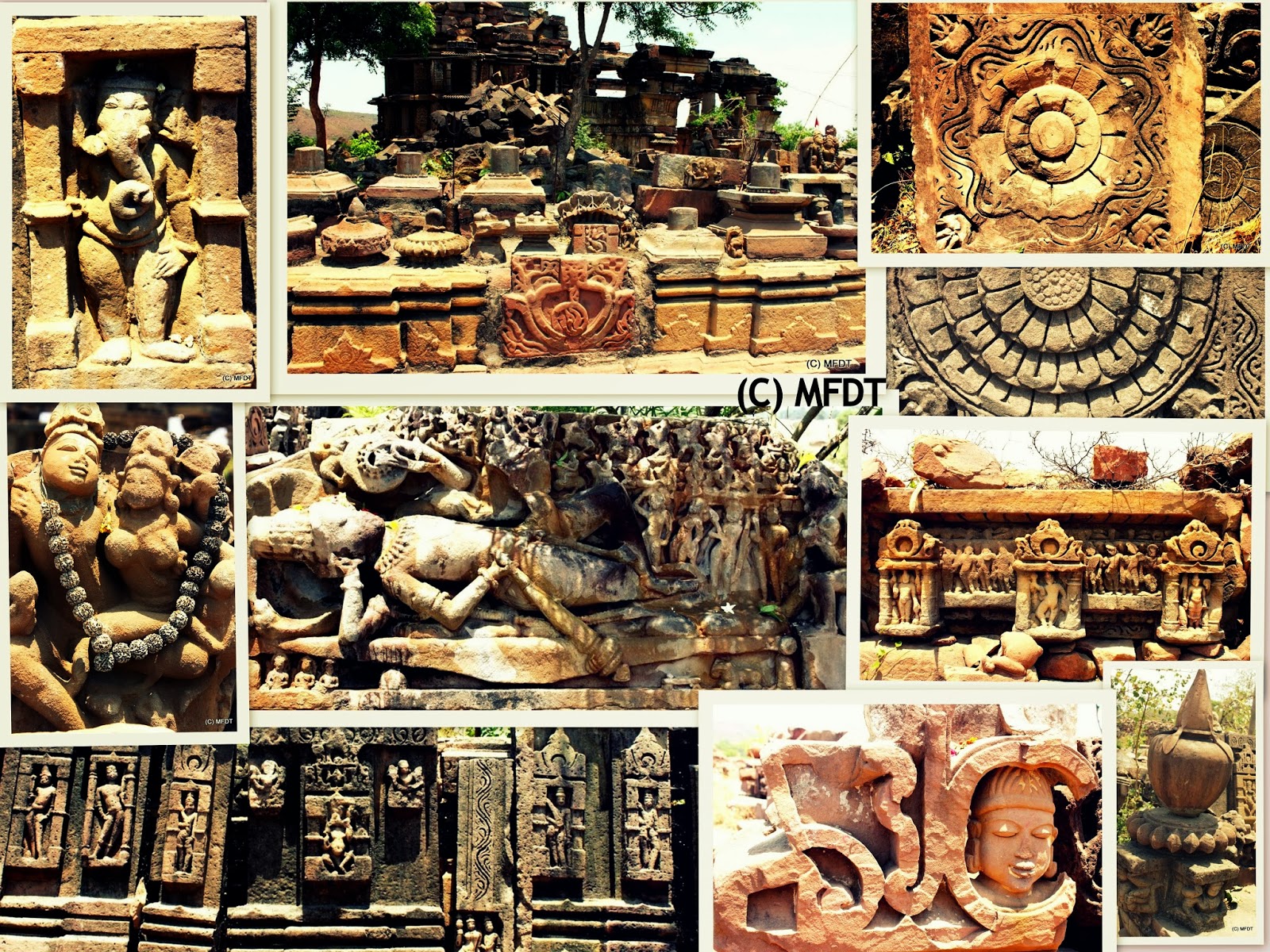
Yet another hidden treasure of the district we could not stop thinking about for days on end is a dilapidated but richly ornate Shiva temple in the village Char, around 4-5 kms from Karwi. Unlike Ganesh Bagh, this temple still has its sanctum sanctorum intact and is still in use for religious purposes.  Strangely though, some people even refer to it as 'Aurangzeb ka Mandir'. While the architecture clearly conveys Chandela origins of the temple, what seems plausible though is that the temple could have been spared destruction by Aurangzeb. Today however, even that can not be claimed given the poor condition in which the priceless sculptures are lying strewn about in the temple complex. The temple has not been afforded any 'protection' by any conservation /restoration agency and whatever little survives to this day, is the handiwork of the sadhus and the local villagers alike. 

Impressive stone sculptures from the temple at Char

Having seen other Chandela temples in Bundelkhand, while one could always consider them capable of imparting life like fluidity to stone sculptures of gods and goddesses, till the day I saw it in Char, I could never imagine an entire Kalash with coconut on top being sculpted in stone with impeccable symmetry (bottom right)!! I wish I could fit in all such awe-inspiring sculptures in this single blog post, but the pictures will never do justice to their actual beauty.

In fact, while writing about the formidable fort of Kalinjar, I had wondered why despite being such an important shrine of Lord Shiva, it has not yet emerged as one of the top Shaivite destinations in the country. Today, while writing this post, I  once again realized, not just Kalinjar but most of the temples in this region are dedicated to Lord Shiva and if visitors start trickling in, perhaps the authorities too will take note of these hidden gems. 

While Amish's Shiva trilogy is quickly lapped up by readers across the country, one hopes these forgotten relics too will get their due one day for whatever reasons it might be. 

“Listen, O lord of the meeting rivers,things standing shall fall,but the moving ever shall stay.” 
― Basava 
(The Lord of the Meeting Rivers: Devotional Poems of Basavanna)


Sunday, 10 June 2012

Charkhari- Kashmir of Bundelkhand

Mangal Garh Fort atop the Mulia Hill. 
The forgotten township of Charkhari suddenly acquired prominence when a political heavyweight decided to contest Assembly elections from this constituency. Otherwise, despite the beauty and the rich history of this pearl of Bundelkhand, little has changed for the residents of this erstwhile Princely State over the past century.

While most places in Bundelkhand reel under severe drought conditions even before the onset of summers, the brimming lakes of the town seem to suggest an entirely different story. It is a rare engineering feat indeed to conserve water by building seven interconnected lakes which supply water to the township even in the driest summer months. But for the roads and the lack of the tourism facilities, the place could have rivaled Orchha and perhaps Jaipur too.

 The Imperial Gazzetteer of India provides insight into the long history of the princely State. 

An old palace in Charkhari


The bylanes of the town are dotted with such magnificent structures


The town had a population of 1,43,000 in the year 1881 but today only 25,000 of its original inhabitants remain. Poor accessibility and lack of any employment opportunities meant that the newer generations had little option in deciding to migrate. 


One Anna, black
The Royal Coat of Arms
During the heyday of its rule, the Princely State of  Charkhari had its own jail, coinage, legal system and police. Some of the stamps belonging to the era are today some of the rarest pieces of India's postal history.


Rani Mahal on the lake
While the current residential palace of the royal family is an ITC hotel, little else has been done to showcase the immense potential of the place to the outside world. The proximity to Khajuraho and Orchha could perhaps someday contribute to the development of the town as an idyllic destination for the curious travelers.